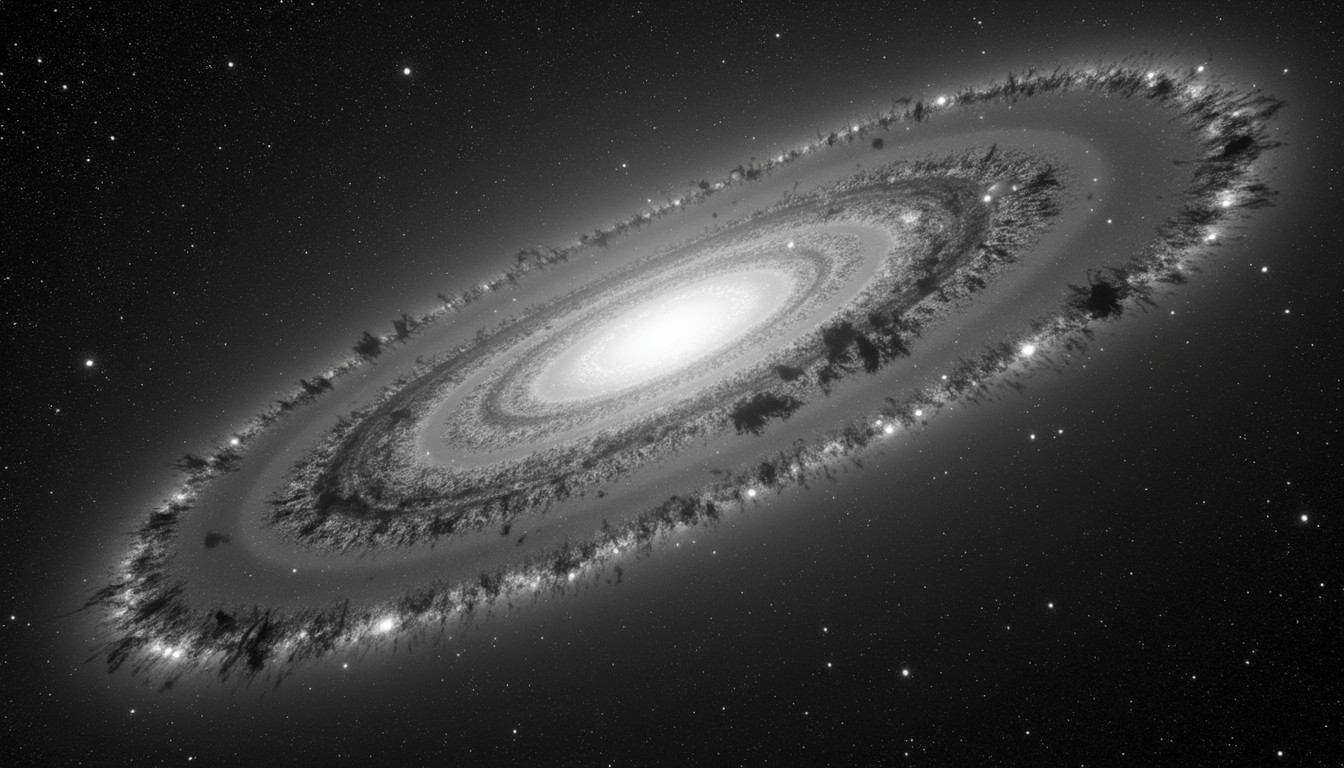
Imagine if 85% of everything around you was completely invisible. You couldn’t see it, touch it, or detect it with any of your senses—yet it was there, affecting everything you do. This isn’t science fiction. This is our universe, and scientists call this invisible substance “dark matter.”
Furthermore, understanding this mysterious substance is one of the greatest challenges in modern science. In this article, we’ll explore what it is, how we know it exists, and why solving this mystery could revolutionize our understanding of the cosmos.
What Exactly Is Dark Matter? Understanding the Invisible Universe
Dark matter is a type of matter that doesn’t emit, absorb, or reflect light. In other words, it’s completely invisible to all our telescopes and instruments. However, despite being invisible, this substance makes up about 85% of all matter in the universe.
To put this in perspective, everything you can see—stars, planets, galaxies, and even you—makes up only about 15% of the matter in the universe. Consequently, the vast majority of the universe is made of something we can’t directly observe.
What Dark Matter Is NOT: Common Misconceptions
Before we go further, let’s clear up some common misconceptions:
Dark matter is NOT:
- Regular matter that’s just dark (like a black hole or dark planet)
- The same as dark energy (which is a different cosmic mystery)
- Antimatter
- Empty space or a void
Instead, dark matter is an entirely different kind of substance that interacts with regular matter primarily through gravity. Moreover, it passes right through normal matter without colliding with it, which makes it incredibly difficult to detect.
How Do We Know Dark Matter Exists If We Can’t See It?
This is the most important question. After all, how can scientists be so confident about something they’ve never directly observed? The answer lies in its effects on things we can see.
Evidence #1: Spinning Galaxies
In the 1970s, astronomer Vera Rubin made a puzzling discovery. She measured how fast stars orbit around the centers of galaxies and found something that didn’t make sense.
Here’s the problem: Stars at the edge of galaxies were moving much faster than they should be. According to physics, they should be moving slower because they’re farther from the galaxy’s center where most of the visible matter is concentrated. In fact, they were moving so fast that they should have been flung out into space, like a ball spinning too fast on a string.
However, the galaxies weren’t flying apart. Therefore, something invisible must be holding them together with extra gravitational pull. That something is this mysterious substance.
Think of it this way: Imagine watching a merry-go-round where children are spinning around. You can’t see the platform, but you can see the children staying in a circle instead of flying off. Similarly, you’d know there must be something holding them in place—even if you couldn’t see it. That’s exactly what we observe with galaxies.
Evidence #2: Gravitational Lensing
Einstein’s theory of relativity tells us that massive objects bend space and light. Consequently, when light from distant galaxies passes near massive objects, it gets bent—like looking through a curved glass lens.
Astronomers observe light bending around galaxy clusters in ways that can’t be explained by the visible matter alone. In addition, the amount of bending reveals that there must be much more mass present than we can see. This invisible mass is what scientists are searching for.
Evidence #3: The Cosmic Microwave Background
Shortly after the Big Bang, the universe was filled with hot, dense matter and radiation. As a result, this ancient light still fills the universe today, though it has cooled and stretched into microwave wavelengths. We call this the Cosmic Microwave Background (CMB).
Moreover, tiny variations in the temperature of the CMB create a pattern across the sky. Scientists can use these patterns like a cosmic fingerprint to figure out what the universe is made of. The patterns match perfectly with a universe that contains about 85% of this invisible substance.
Evidence #4: Galaxy Cluster Collisions
When galaxy clusters collide, normal matter (mostly hot gas) slows down and gets stuck in the middle because gas particles crash into each other. However, dark matter doesn’t interact with itself or normal matter except through gravity, so it passes right through.
The Bullet Cluster is a famous example where astronomers observed exactly this. The visible matter (detected by X-rays) separated from where most of the gravitational mass was located (detected by gravitational lensing). Therefore, this showed that most of the mass was invisible matter passing through the collision.
What Could Dark Matter Be Made Of? Exploring the Candidates
This is where things get really interesting. Scientists don’t know exactly what it is, but they have several compelling theories.
WIMPs: Weakly Interacting Massive Particles
For many years, the leading candidate was WIMPs (Weakly Interacting Massive Particles). These theoretical particles would be:
- Heavy (much heavier than protons)
- Barely interacting with normal matter
- Left over from the Big Bang in huge quantities
However, despite decades of searching with incredibly sensitive detectors deep underground, scientists haven’t found definitive evidence of WIMPs yet. Nevertheless, the search for these mysterious particles continues.
Axions: Tiny Ghostly Particles
Another candidate is the axion—an extremely light, ghostlike particle that was originally proposed to solve a different physics problem. In contrast to WIMPs, axions would be incredibly numerous but individually very light.
Furthermore, axions could form into strange quantum states called “Bose-Einstein condensates” that might behave differently than WIMPs. Several experiments are currently searching for these elusive particles.
Primordial Black Holes
Some scientists think dark matter could be primordial black holes—tiny black holes formed in the first moments after the Big Bang. Unlike WIMPs or axions, these would be made of normal matter compressed to extreme density.
However, recent observations have made this explanation less likely for most of the universe’s invisible mass, though it could account for some of it.
Something We Haven’t Thought Of Yet
Perhaps the most exciting possibility is that dark matter is something completely unexpected—a type of matter or phenomenon that requires entirely new physics to understand. After all, the history of science is full of surprises, and it may turn out to be stranger than we imagine.
How Are Scientists Searching for Dark Matter Today?
The hunt for these mysterious particles uses three main approaches, each tackling the problem from a different angle.
Direct Detection Experiments
Scientists place ultra-sensitive detectors deep underground (to shield them from cosmic rays and other interference). These detectors wait patiently for one of these elusive particles to bump into an atomic nucleus. Specifically, experiments like XENON, LUX, and SuperCDMS use different techniques to catch these rare interactions.
Moreover, these detectors are so sensitive they can detect single nuclear recoils—like hearing a whisper in a silent room.
Particle Colliders
The Large Hadron Collider (LHC) at CERN tries to create these particles by smashing normal particles together at enormous energies. In other words, if they exist, perhaps we can make them in the lab.
Scientists look for “missing energy” in collisions—energy that disappeared, possibly carried away by invisible particles. However, identifying them this way is challenging because you’re looking for what you can’t see.
Indirect Detection
Some experiments look for the products of dark matter particles annihilating each other. For example, when two of these particles collide and destroy each other, they might produce gamma rays, neutrinos, or other particles we can detect.
Additionally, space telescopes like Fermi and ground-based telescopes search for these signals coming from regions where this invisible substance should be concentrated, like the center of our galaxy.
Why Does Dark Matter Matter? The Cosmic Significance
You might wonder why we should care about invisible stuff floating around in space. The answer is profound: dark matter is fundamental to understanding our universe.
How Dark Matter Shaped the Universe
Without dark matter, galaxies as we know them wouldn’t exist. Furthermore, in the early universe, its gravity pulled normal matter together, creating the seeds that grew into galaxies, stars, and eventually planets and life.
In essence, this invisible substance provided the cosmic scaffolding upon which everything we see was built. We literally wouldn’t be here without it.
It Challenges Our Understanding of Physics
The existence of dark matter tells us that our current understanding of physics is incomplete. Consequently, discovering what it is could lead to revolutionary new physics—similar to how the discovery of quantum mechanics transformed our understanding of the atomic world.
It’s Most of the Universe
We can’t claim to understand the universe when we don’t know what 85% of it is made of. Therefore, solving the dark matter mystery is essential to completing our picture of reality.
Could We Be Wrong About Dark Matter? Alternative Theories
It’s worth asking: what if there is no dark matter? What if our understanding of gravity is wrong instead?
Modified Gravity Theories
Some scientists have proposed that gravity might work differently on cosmic scales than we think. For instance, Modified Newtonian Dynamics (MOND) suggests that gravity gets stronger at very low accelerations, which could explain galaxy rotation without needing this invisible substance.
However, while MOND can explain some observations, it struggles with others—particularly gravitational lensing and the Cosmic Microwave Background patterns. Moreover, most evidence points strongly toward it being real.
Nevertheless, scientists keep an open mind. After all, challenging established ideas is how science progresses.
The Dark Matter Puzzle Today: Where We Stand
As of 2026, this cosmic mystery remains one of the biggest unsolved mysteries in science. Despite decades of searching, we still haven’t directly detected the particles. However, this doesn’t mean we’re stuck.
Recent Developments
Scientists continue to:
- Build more sensitive detectors
- Explore new theoretical possibilities
- Use better telescopes to map its distribution
- Run more powerful particle collider experiments
- Develop new techniques to search in unexplored regions
Furthermore, each experiment that doesn’t find it actually helps by ruling out possibilities and narrowing down where to look next.
What’s Next?
The next generation of experiments promises unprecedented sensitivity. For example:
- LZ (LUX-ZEPLIN) uses seven tons of liquid xenon to catch these elusive particles
- SuperCDMS SNOLAB will operate at incredibly cold temperatures near absolute zero
- Future space telescopes will map its distribution with greater precision
- New particle colliders might reach energies where the particles could be produced
Additionally, scientists are thinking creatively about completely new ways to search, including using quantum sensors and looking for effects in precision measurements of fundamental constants.
What Would Finding Dark Matter Mean for Science?
Discovering it would be one of the greatest scientific achievements in history. Specifically, it would:
Transform Physics
Understanding it could reveal new fundamental forces, particles, or principles that we never imagined. In other words, it could be as revolutionary as discovering quantum mechanics or relativity.
Answer Cosmic Questions
We’d finally understand how galaxies form, how the universe evolved, and what the cosmos is truly made of. Moreover, this could answer questions we haven’t even thought to ask yet.
Open New Technologies
Throughout history, fundamental discoveries have led to unexpected technologies. For instance, quantum mechanics led to computers and lasers. Similarly, understanding dark matter could lead to technologies we can’t yet imagine.
What Can You Do?
You might think dark matter research is only for professional scientists, but there are ways anyone can engage with this cosmic mystery:
Stay Curious
Follow the latest discoveries. Several science websites and YouTube channels cover dark matter research in accessible ways. Furthermore, many scientists share their work on social media.
Support Science
Scientific research requires funding and public support. Therefore, staying informed and supporting science education and research helps push these frontiers forward.
Ask Questions
Science thrives on questions. Don’t be afraid to wonder about the universe. After all, every major scientific breakthrough started with someone asking “why?” or “what if?”
The Beauty of Not Knowing
There’s something profound about living in a time when we know that 85% of the matter in the universe is a mystery. In other words, we’re aware of our ignorance, which is the first step toward knowledge.
Moreover, this uncertainty isn’t a weakness of science—it’s its strength. Science doesn’t pretend to have all the answers. Instead, it provides the tools to find them.
Conclusion
Dark matter remains one of the universe’s deepest mysteries. We know it exists through its gravitational effects on galaxies, galaxy clusters, and the entire cosmos. However, we still don’t know what it is.
This invisible substance makes up most of the matter in the universe, shaped the formation of galaxies, and played a crucial role in creating the conditions for life. Furthermore, understanding it will likely revolutionize our understanding of physics and the cosmos.
The search continues in underground laboratories, particle colliders, and telescopes around the world. Consequently, we may be on the verge of one of the greatest discoveries in human history—or we may need entirely new ways of thinking about the problem.
In essence, dark matter reminds us that the universe is far stranger and more wonderful than we ever imagined. It challenges us to think beyond what we can see and touch, to trust in mathematics and evidence, and to never stop asking questions about the cosmos we inhabit.
Finally, whether you’re a student, a curious adult, or simply someone who looks up at the night sky and wonders, this cosmic mystery is a reminder that we live in an age of discovery. The universe still has secrets to reveal, and perhaps—just perhaps—the next breakthrough is just around the corner.
The hunt for dark matter continues at research facilities worldwide. While we haven’t found it yet, each experiment brings us closer to understanding this cosmic mystery. Stay curious, keep learning, and remember: the most exciting phrase in science isn’t “Eureka!” but “That’s interesting…”